

European Quality Circle

Closing the gap between responsible-sourcing ambitions and operational reality.

Independent advisory for luxury brands and their suppliers across the diamond, jewelry and watch industries, built on 45 years of hands-on experience.

My position

A supply chain can look perfect on paper and still carry serious risks.

With 45 years of experience across the diamond, jewelry and watch industries, from rough sourcing and manufacturing to the supply chains of leading luxury brands, I have learned that declared practices often differ from reality.

I work with luxury brands and their suppliers to close the gap between responsible-sourcing ambitions and operational realities.

From 2019 to 2026 I chaired the Responsible Jewelry Council (RJC) Assurance Committee. Today, I advise a select group of organizations on supplier qualification, due diligence, traceability, responsible sourcing and supply chain risk.

I do not tell companies what they want to hear. I show them what is actually happening, what can be verified, where the risks lie, and what will stand the test of time.

What I do

Independent advisory across nine disciplines.

Supplier qualification

Selecting and vetting the right suppliers, beyond questionnaires and self-declarations.

Due diligence

Practical due-diligence frameworks aligned with OECD guidance and brand expectations.

Traceability

Designing traceability programs that hold up under audit and customer scrutiny.

Responsible sourcing

Translating ESG and human-rights commitments into operational reality on the ground.

Supply chain risk

Identifying where risk actually lives, geography, tier, product, counterparty.

Compliance & brand-readiness

Preparing suppliers to meet luxury-brand compliance standards and audit cycles.

Strategic advisory

Management consulting, HR, customer service and strategic planning for jewelry-sector leaders.

Production-line structuring

Structuring production lines in diamond factories to align with brand requirements, and verifying production flow, capacity and actual delivery.

Now AvailableLimited SpotsOnline booking — coming soon

Private Jewelry Buying Advisory

Before you buy, avoid an expensive mistake. Get an independent expert opinion before you spend thousands. I do not recommend where to shop — I teach you what to look for, what questions to ask, and what fair value actually means, so you buy with confidence, not guesswork.

Is this a good offer? I will tell you honestly.

What to inspect before you say yes.

What you should reasonably spend for this piece.

Red flags that salespeople hope you miss.

Contact me by email to reserve your spot

The right advice costs less than the wrong diamond. One expert opinion can save you from the wrong purchase. Online payment by credit card will be available shortly.

EQC founder portrait

The founder

Forty-five years inside the trade.

A career spanning rough-diamond sourcing, manufacturing, jewelry and watch supply chains, and advisory roles to the world's leading luxury brands.

Chair, RJC Assurance Committee, 2019 to 2026. Seven years at the center of how the responsible-jewelry sector defines and verifies its standards.

Today, working with organizations on the questions that matter most to their licence to operate: who is in your supply chain, what can you actually prove about them, and what risk are you carrying without knowing it.

Insights

Writing & perspectives

Article· June 12, 2026

Traceability Is Not Transparency

And the difference will define the next decade of our industry.
Traceability Is Not Transparency

Traceability, sustainability, ESG, compliance, and responsible sourcing are everywhere in the diamond, jewelry, and watch industry today. Brands ask for them. Regulators demand them. Consumers expect them.

But one question keeps troubling me: Are we all talking about the same thing?

We often speak about traceability and transparency as if they mean the same thing. They do not.

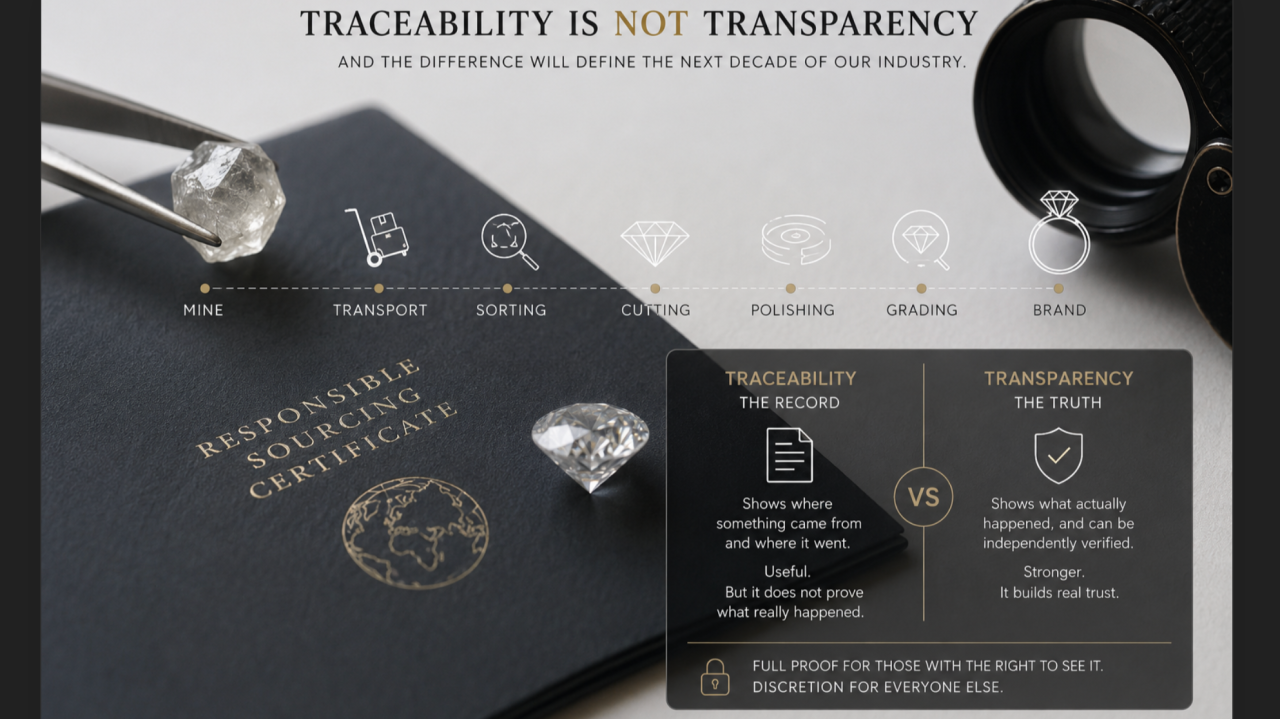
Traceability tells us where a product came from and where it went.

Transparency tells us what actually happened along the way.

The first is a record. The second is proof. A product can be "traceable" through declarations, certificates, invoices, and even blockchain records. But none of these alone proves what is true. A blockchain only preserves what was entered. It cannot guarantee that the first declaration was honest. These documents support a claim. They do not verify it.

This difference matters more every day. Sanctions on Russian goods. G7 traceability rules tightening through 2026. The coming Digital Product Passport. A new generation of buyers who ask not only what they buy, but where it truly came from. Responsible sourcing is no longer a value. It is a requirement. Compliance, once a differentiator, is now simply the price of entry.

And here is the second source of confusion: many supply chains can demonstrate compliance. Very few can show what actually happened. Compliance proves a process exists. Visibility proves what happened inside it. As pressure rises, compliance alone will not be enough.

There is a reason the industry hesitates. Transparency means something different to everyone. Brands want confidence in origin, compliance, and risk. Suppliers want to protect their pricing, margins, sourcing strategies, and relationships. Auditors want evidence. Regulators want accountability. Consumers want trust.

Almost everyone agrees that more transparency is good. The real debate starts when transparency becomes visible, auditable, and verifiable. How much should be shared? With whom? Under what conditions? This is where the conversation becomes uncomfortable.

But here is what many have missed: transparency and confidentiality are not opposites.

The future does not require showing everything to everyone. It requires that every transaction, every transformation, and every participant be recorded, traceable, auditable, and independently verifiable, while commercially sensitive information remains protected and is shared only with those who have a legitimate need to know.

Full proof for those with the right to see it. Discretion for everyone else. That is not a contradiction. That is the maturity our industry has been missing.

For generations, our industry was built on trust. That trust is precious, but today, trust must be backed by verification.

The question is no longer: "Can we trace a product?"

The question is: "Can we independently verify what actually happened?"

Now imagine a supply chain, from mine to brand, where every step can be traced, verified with certainty, audited, and protected. Where origin is proven, not declared. Would that change how brands evaluate risk? Would verified transparency become the new competitive advantage?

I believe it would. And I believe that the future is nearer than many think.

The companies that will lead the next generation of responsible sourcing will not be those with the most certificates or the most declarations. They will be the ones who create trust through evidence, verification, and accountability, while respecting legitimate confidentiality.

So perhaps the most important question facing our industry today is no longer: "How do we achieve traceability?"

but rather: "How do we create trust through verification, while protecting confidentiality?"

The answer to that question will shape responsible sourcing, sustainability, and transparency for many years to come.

Article

The Diamond Industry Is Undergoing a Profound Transformation

From a volume-driven commodity trade to a value-driven luxury experience.

The diamond industry is undergoing a profound transformation, from a volume-driven commodity trade to a value-driven luxury experience. Luxury brands now demand unprecedented levels of transparency, sustainability, and direct control over the supply chain, while mining companies seek to capture greater value through vertical integration, technology, and direct partnerships.

This convergence of ethical consumer expectations, advanced traceability tools such as blockchain, and strategic supply alignment is redefining the industry's future. In this new landscape, only those who embrace transparency, ESG accountability, and innovation will remain relevant, while traditional volume-based players risk obsolescence in an increasingly conscious and connected marketplace.

Article

After 45 Years in the Diamond Industry

Real change does not announce itself. It simply becomes the new standard.

After 45 years in the diamond industry, I have learned that real change does not announce itself. It simply becomes the new standard.

We are at this moment now.

Leading watch and jewellery brands are restructuring their supply chains. They focus on ESG, accountability, clear origin of diamonds, compliance, measurable standards, and transparency.

Today, being a relevant supplier is not only about a long history or good relationships. It is about having the right structure.

Can a supplier demonstrate proper due diligence and clearly explain the origin of the diamonds?

Is transparency truly part of the daily process?

Brands are choosing partners who can answer these questions with clarity and confidence.

The suppliers who stay relevant will be those who strengthen their foundation and meet the standards that serious brands require today.

Post

Six months into our strategic partnership between EL-RAN and Windiam, I'm pleased to reflect on how well this collaboration has worked. It has strengthened our combined capabilities while ensuring continuity for our valued customers. Working with the exceptional Windiam team makes this an exciting partnership. Exciting times ahead in our industry.

Post

A supply chain can look perfect on paper and still carry serious risks.

In 45 years in the diamond and jewelry industry, I have seen audits passed, certificates issued, and boxes ticked, while the real problems sat quietly in operations, waiting.

The companies that avoid surprises are not the ones with the thickest files. They are the ones who ask a harder question: "What can we actually verify?"

If you only read declarations, you only know what someone wanted you to know.

Post

So, you are a proud natural, polished diamond manufacturer. Maybe your factory is RJC-certified and even BPP-certified, and you participate in many, or even every, international industry fair. Investing in a beautiful booth, sending your best team, mostly the same team. But your competitors are doing just the same; everyone posts nice photos on social media from the booth and the team, and it all looks the same. Now, you want to attract customers, you want the customers to come to you and not to your competitors. But after all, you mostly offer the same type of goods and assortments or even certs.

So if I am a potential customer, where shall I go? Where shall I buy? It's hard to decide and time-consuming to start meeting all of you who offer the same. How do you make me choose you or your company?

Article

Our Industry Is Being Watched Like Never Before

G7 traceability is now active. Luxury brands are moving fast. And many of us are still not ready.

Our industry is being watched like never before.

G7 traceability is now active. Luxury brands are moving fast. And many of us are still not ready.

Our industry is entering a new era, and I believe we all recognize this transformation. The luxury brands we serve, especially in Swiss watchmaking and jewellery, are moving quickly toward supply chains that are verified, documented, and transparent. Standards are rising steadily. What was enough yesterday is not enough today, and what is enough today will not be enough tomorrow. We all feel this shift, and it is happening faster than many expected.

No one is asking us to reveal confidential business information. The real issue is that our customers must meet new standards, and they will expect the same from us. These requirements are becoming stricter and will not go back.

In the months and years ahead, for every parcel, we will need to provide:

Verifiable proof of origin, not declarations. Full chain-of-custody documentation. Clear disclosure of where each stone or melee parcel was actually polished. Compliance with G7, RJC, and ESG standards. Strengthened due diligence and responsible sourcing practices.

Those who are ready to meet these requirements will grow together with the brands. Those who are not prepared will find it difficult to continue.

I am sharing this as an industry member with many years in our trade. My goal is to help us move forward together, not to warn, but to encourage. It is better for us to adapt now, as a group, than to face challenges alone later.

Today, our industry is under more attention than ever. The question is not if we will change, but if we will lead this change.

Post

Last week, I received a cold email from a diamond manufacturer in India. Their message was honest, and their intention was good. However, they lacked RJC certification, traceability, and an ESG framework.

It would have been easy to ignore or delete this message.

But I decided to reply. I asked them the important questions. They answered honestly and explained that they are not ready yet.

I gave them what they needed most: clear direction. I explained the importance of RJC certification and connected them with the right person to help them get started.

These manufacturers are taking initiative and looking for new opportunities outside their local market. They are reaching out because they want to grow. They simply do not yet know the standards that our industry requires today.

If we only speak with those who are already compliant, we do not help the industry to move forward. We only protect our own position.

To all sustainability managers, brand owners, brand buyers, and compliance leaders: when you receive an email like this, take five minutes to reply. Give guidance. Show them the way to RJC, to ESG resources, and to the right contacts.

This is how we create real change in our supply chain. We do not close doors. We show others where the door is and how to enter.

Post

What if a fully transparent, traceable, and auditable solution existed for small diamonds, the melee and very small diamonds used in quantity across watches and jewelry, where a diamond's entire journey, from rough to a finished stone, could be independently verified rather than simply declared?

What would stop a brand from using it?

Imagine origin proven, not promised. Every step is accountable. Every claim is backed by evidence, not by someone's word.

If such a model existed, would there be any reason not to adopt it?

I'd be interested to hear your view...

Article· April 5, 2024

Navigating the Traceability Imperative: A Call to Action for the Diamond Industry

The demand for diamond source declarations is reshaping our industry — and the time to act is now.

The recent article from Rapaport News has spotlighted a pivotal issue within the diamond industry: the necessity of traceability. It's clear that the demand for source declarations for diamonds, irrespective of size, is more than just a passing trend. This demand is reshaping how we conduct our business, and the ramifications for those who haven't embraced traceability solutions are now front and center.

Tools to trace a diamond's journey—iTraceiT, Sarin, Tracr, GIA, and Everledger—have been available for some time. These solutions offer more than just compliance; they provide a way to ensure continued trust and confidence in our products. The industry leaders who were quick to adopt these practices are now benefiting, showcasing a forward-thinking approach that aligns with the values of modern consumers.

The predicament outlined in the article concerning sanctions and the resulting chaos is a consequence of the industry's slow collective response to change. But rather than being mired in frustration, this should be our wake-up call. Solutions like iTraceiT, which cater to small parcels and large stones, offer a way forward. They maintain traceability through all processes, be it splitting or merging—ensuring the origin story of the diamond remains intact.

Why endure the struggle and risk of being the subject of such concerning news when adopting a traceability system suited to your business needs can pave the way for responsible supply and customer satisfaction?

Now is the moment to act. It's about equipping ourselves with the right tools and mindset to navigate the current landscape and future-proof our operations against stricter regulations down the line. Let's not wait to become a story about what went wrong. Instead, let's be the story of what it means to adapt and thrive.

I urge my peers and industry colleagues to reflect on this turning point and to exchange ideas and strategies on how we can collectively ensure the integrity and trustworthiness of our supply chain. Whether it's iTraceiT or another system, let's share our successes and lessons learned. Together, we can solidify our industry's reputation for excellence and reliability in the eyes of all stakeholders involved.

Contact

Start a conversation.

For new advisory engagements, speaking invitations, or a confidential second opinion on your supply chain.